Central Heating Thermostat Positioning

Central Heating Thermostat Positioning

When it comes to choosing the best place to position a central heating thermostat there are a few general dos and don’ts that can affect how well your heating system works. Obviously, you DO want to put it in as convenient a place as possible, but you DON’T want to position a thermostat in a spot that could potentially cost you money and see your home’s heating work overtime. So we’ve put together this quick guide to help you make sure your thermostat is in just the right spot to do its job properly. But first, what are central heating thermostats and how do they work?

What Is A Central Heating Thermostat

A central heating thermostat is a set of controls used to regulate the output of your heating system, to make sure a comfortable temperature is maintained. Heating thermostats work by monitoring the average temperature of your home and sending a signal to a boiler to ensure it’s never too hot or too cold. You can manually set the temperature to a level you like and the thermostat will click into operation to get it there, and when that temperature has been achieved the thermostat will switch off the heating to ensure it doesn’t go above the level you selected. If the temperature of your home drops, the thermostat kicks back in to inform the boiler it needs to fire up and raise it again. Since thermostats sense the ambient temperature, their position is very important, because external factors could affect the temperature of a room and give a false reading. So where should and shouldn’t your thermostat be positioned?

What’s The Best Place To Position A Thermostat?

Do Place Your Central Heating Thermostat

  • On an interior wall

Placing your thermostat on an interior wall will give a more accurate reading because they are a better indication of the average temperature of your home. External walls are often much cooler, so the thermostat will tell the boiler to warm the house up when it might not need to.

  • In a frequently used room

We all want the rooms that we use the most to be at the most comfortable temperature. So it makes sense to install the thermostat in a frequently used space like the living room so that it is just the right temperature all year round.

  • Near the center of your home

As we mentioned earlier, the thermostat measures the average temperature of your home. And what is another word for average? Middle or center! So the middle of your home will give you the most accurate average reading since it will measure the centrally circulating air.

  • 5ft above the floor

Heat rises, so if your thermostat is very high up the wall it will give you an inflated reading and tell your boiler to cool the house down. About 5ft above the floor is the most common place to install your thermostat for an accurate average reading.
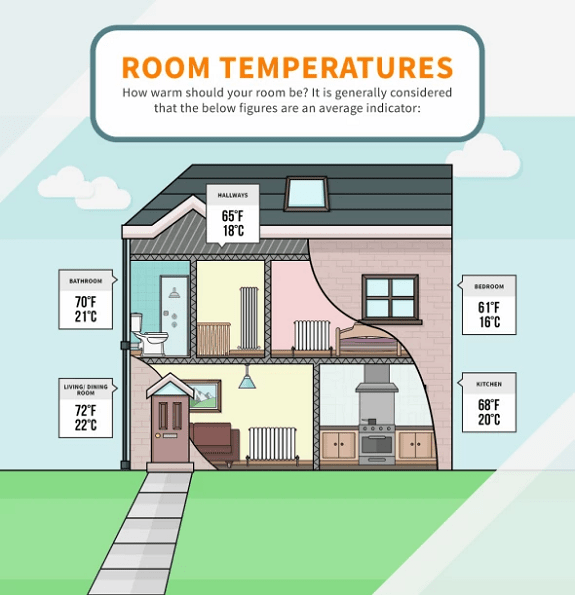
It is a good idea to avoid placing your thermostat in the following areas as these volatile zones are subject to other heat sources and extreme temperature variations.

Don’t Place Your Central Heating Thermostat.

  • Above a radiator
  • In direct sunlight
  • In the kitchen
  • Near windows or doors
  • In the hallway
  • Above air vents

Whether it’s a cold draft from the front door or a blast of heat from the oven, a consistently up and down temperature will confuse your thermostat meaning your home won’t reach the comfortable set temperature and could potentially waste energy.

Should The Thermostat Be In The Coldest Room?

We would not advise putting the thermostat in the coldest room as this would not be a true reflection of the temperature of the rest of the house. You want an average reading for it to work efficiently so placing it in the coldest part of the house would be an extreme cold air temperature zone to avoid. If the thermostat senses cold, it will think that your entire home is just as cold. So it will tell your boiler to work harder which could increase your heating costs. For the same reason, the thermostat shouldn’t be placed in the hottest part of the house. Putting the thermostat in a very warm room tells the sensor that the house is too warm and so the boiler turns the heating down when you might not want it to.

Should The Thermostat Be Upstairs Or Downstairs?

Since heat rises, the upstairs rooms will often feel warmer than the downstairs rooms. So an upstairs thermostat might think your entire home is getting too warm and start cooling it down. Instead, we would advise placing your thermostat in a centrally located downstairs space that is used often, like the living room.

What About TRVs?

TRVs, also known as Thermostatic Radiator Valves, do a similar job to your room thermostat, hence their name. So, if you do have TRVs in individual rooms, you will need to avoid placing your thermostat in the same room as them – or at the very least quite far apart. This is to ensure that they don’t compete with each other to increase or decrease the temperature.

What temperature should I set on my thermostat in winter?

During wintertime in the UK, most people set their central heating thermostat to 20°C. This will make sure that your home is comfortable and warm throughout the coldest time of the year.

Where Should A SMART Thermostat Be Positioned?

If you have a SMART Thermostat, make sure it is positioned in the range of your Wi-Fi and that it has a strong connection.  Also, keep it out of the way of anything that might block the sensors such as behind a door or cabinet.

So, after all that technical thermostat talk let’s go over the bits you need to remember to control your heating effectively.

There are 4 key points to remember when choosing where to position a central heating thermostat –

  • Place it in the centre of your home.
  • On an interior wall.
  • Aim to position it about 5ft above the ground.
  • In a room that you use a lot.

If you find the sweet spot, your thermostat will consistently give an accurate average reading to ensure your central heating system runs efficiently and keeps your entire home at a comfortable temperature. Courtesy of John Lawless

You may think it is cheaper to provide the materials yourself, but it is not – therefore…

Homeowners do not realise the problems that can occur when doing the simplest of projects. When things go wrong, as they do on most projects, both the homeowner and the contractor lose. For the homeowner, the money they save is eaten up by having to pay for the additional labour the contractor incurred. The contractor might have a tough time collecting payment for the extra hours incurred because the homeowner is unhappy, and they run the risk of damaging materials that someone else purchased (like cutting the base of a cabinet to accommodate plumbing pipes).

We charge up to 20% on materials and consumables we supply, and we understand that owners want to know why we need to charge a markup on the materials. Owners believe that they will save money if they buy their own materials and just hire a contractor to install them. Owners may have shopped around and are convinced they know exactly what they want and where to get it. They found the store or warehouse with the best prices, and they know exactly where and how they want it installed. They have heard (or they know!) that contractors are pirates. They figure if they supply the materials, they will not have to worry about you tacking overhead and profit on those materials. How hard can it be to find a part for a toilet? It is also fuelled by suppliers who encourage owners to buy their own materials. They would rather make the sale to the customer standing in front of them than hope the contractor will come back to buy from them.

That is why homeowners want to purchase their own materials. Now let us look at what they expect from their contractor. They will furnish the materials, and the contractor will not only install them but also guarantee them. They expect the contractor to install them in a good and skillful manner, regardless of the kind or quality of the materials supplied. Additionally, if their materials do not fit or look right, the contractor will need to tear them out at the contractor’s expense and put in new materials the owner will furnish as soon as they can get them to the job site. The Contractor will be expected to just shut down the job while they wait.

If, during the tear out of the owner’s materials, the contractor damages something, the contractor will be expected to fix or replace the damaged item at their expense. Sometimes the contractor will be expected to give a credit off the final bill because of the aggravation caused to the owner. Or worse, they will decide the contractor cannot be trusted so they order the contractor off the job and hire a “competent” contractor to finish it. The contractor will be expected to pay the difference and get poor reviews on social media. These scenarios may seem laughable but over 35 years we have been down this road many times. We do feel that potential clients need to be educated on what their responsibilities will be when they furnish their own materials.

If there are any problems with the materials you purchase, you will be responsible for not only replacing those materials, but also any surrounding or attached parts that might have been damaged or destroyed. Additionally, you will pay more than twice for the labour; you will pay for the first install, for the removal of the first install, then for the second install. All the risk regarding the materials is the owner’s. If there are delays on the works due to items not arriving or coming damaged, you will need to pay the contractor for loss of earnings. Anything to do with warranties or guarantees with the products you supply will be your problem to sort out.
If clients want a labour only job then why not just go down to the job centre and find a plumber there? But no, the client wants YOUR labour because you are the one with training, qualifications and a good reputation. And for all that experience they still want to pay you like the babysitter or ask you to work for cash and knock off the VAT which is illegal.

If the contractor provides both the labour and the materials for the job and guarantee it as they should or as required by the manufacturer, any expense for repair or replacement is the contractors.
Owners need to know the time that will be involved in getting all the parts together. However, owners think that “supplying all the materials” means telling you where they can buy the materials. And do they really mean ‘all the materials’ how about the screws, the silicone, the plaster? Clients tend to mean the big-ticket items and not the essentials and are looking for the contractor to bear the cost of those.

The client must get the parts, bring them to the work area, haul them upstairs or through tight places without damaging anything, check for missing or damaged parts, get them returned and replaced without holding up the job. If the contractor must be cancelled, you may be charged for this aborted work and find it difficult to get the contractor back within a good timeframe due to other work commitments.

Invariably when the owner supplies the materials it ends up costing them more and puts everyone in risk of a job dispute. If the materials supplied by the owner are of inadequate quality, and then cause damage to the property, the owner needs to claim off their insurance, resulting in increased premiums.

Any mark up on materials a contractor makes covers things like; insurance, staff training, paying someone to answer the telephone, vehicles, tools and so on. If a client really wants to pay labour only, they still expecting that labour costs to include the purchase and use of tools and consumables. So, it is not really labour only ever, is it?

Food for thought.

Christy Plumbing & Heating
Privacy Overview

This website uses cookies so that we can provide you with the best user experience possible. Cookie information is stored in your browser and performs functions such as recognising you when you return to our website and helping our team to understand which sections of the website you find most interesting and useful.