Aug 14, 2026 | Company News
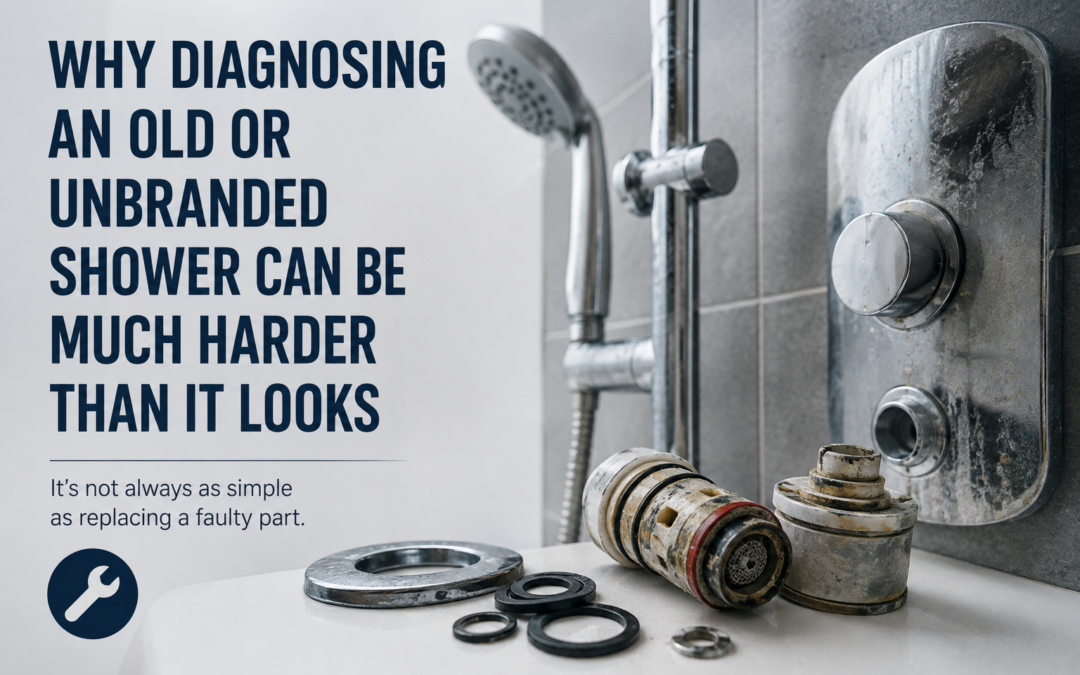
Why diagnosing an old or unbranded shower can be much harder than it looks
When a shower stops working properly, it is understandable that a customer might think the solution is simple:
“Can’t you just replace the faulty part?”
Sometimes the answer is yes.
But with older, unbranded, poorly maintained or heavily worn showers, identifying the actual cause of the problem can be surprisingly difficult. A shower that is running cold, losing pressure, dripping, cutting out or refusing to work properly may have several possible causes — and replacing one component doesn’t necessarily solve the underlying fault.
At Christy Plumbing & Heating, we regularly attend showers where the customer has already been told, or reasonably assumed, that one particular part will fix everything. Unfortunately, plumbing and shower systems don’t always work that way.
A shower is a system, not just one component
A shower can contain or rely upon a number of components working together, including:
- The shower valve or mixer
- Thermostatic cartridge
- Flow control
- Diverter
- Check valves
- Filters
- Shower head and hose
- Pump, where fitted
- Hot and cold water supplies
- Isolation valves
- Pipework
- Electrical components on electric or digital showers
- Internal seals and diaphragms
- Pressure and temperature regulation
If one part isn’t working correctly, another component may also be affected.
For example, poor flow from the shower head could be caused by the shower head itself — but it could also be caused by a blocked filter, a restriction in the valve, poor water pressure, a failing pump or an issue with the incoming supplies.
Simply changing the shower head might therefore make little or no difference.
“The cartridge must be faulty” — but is it?
Thermostatic cartridges are a common source of shower problems, particularly on older showers.
A cartridge can become worn, scaled up or damaged. It may cause:
- Water that won’t get hot enough
- Temperature fluctuations
- Poor flow
- A shower that won’t shut off properly
- Water coming through when it shouldn’t
- Difficulty adjusting the temperature
But these symptoms don’t automatically mean the cartridge is the problem.
The cartridge could be functioning correctly while another part of the system is causing the symptom.
This is why a competent plumber should diagnose the shower before simply ordering a replacement component.
The problem with old and unbranded showers
Modern showers from established manufacturers will normally have identifiable model numbers, replacement parts information and technical documentation.
That makes diagnosis considerably easier.
With an older or unbranded shower, things can be very different.
We may encounter a shower where:
- There is no visible manufacturer
- The model number has disappeared
- The shower has been installed for many years
- Replacement parts are no longer manufactured
- Several visually similar cartridges are available
- Previous repairs have been carried out
- Parts from different manufacturers have been fitted
- The shower has suffered from limescale
- Filters or internal components have never been maintained
- The original installation doesn’t meet current expectations
- Access to the internal components is extremely restricted
In these circumstances, identifying the correct component can become a job in itself.
Why plumbers can’t always diagnose a shower fault in five minutes
A customer sees the end result:
“The shower isn’t getting hot.”
A plumber sees a number of possible causes.
Is the hot water supply reaching the shower?
Is the cold water pressure correct?
Are the isolation valves fully open?
Are filters blocked?
Is the cartridge operating correctly?
Is the thermostatic element responding?
Is there a restriction in the pipework?
Is the shower receiving the correct flow?
Is a pump operating correctly?
Is there a problem elsewhere with the hot water system?
Has somebody previously altered or repaired the shower?
These questions have to be worked through before a plumber can confidently identify the root cause.
Sometimes this means removing parts, testing the water supplies, inspecting filters and valves, checking temperatures and pressures, and examining the condition of the shower itself.
The danger of “just replace the part”
Replacing a part without properly diagnosing the fault can result in an expensive cycle of trial and error.
For example:
Customer: “The shower isn’t getting hot.”
Part replaced: Thermostatic cartridge.
Result: Still not hot.
Next part: Flow control.
Result: Still not hot.
Next part: Check valve.
Result: Still not hot.
At this point, the customer may have spent considerably more money and still have the original problem.
A professional diagnosis should aim to establish why the shower is malfunctioning before recommending a repair wherever reasonably possible.
Sometimes the part is the problem — and sometimes the shower is the problem
There is another important consideration with older showers.
Even if we identify a failed component, that doesn’t necessarily mean replacing it is the best long-term solution.
If a shower is 15 or 20 years old, has significant limescale, worn seals, obsolete components and evidence of previous repairs, spending money replacing one component may only provide a temporary solution.
There may be another component close behind it in terms of failure.
In these circumstances, we may recommend comparing the cost of repair with replacement.
That isn’t about selling a new shower unnecessarily.
It is about making sure the customer understands the likely condition of the whole appliance rather than simply replacing one component and hoping for the best.
Why replacement parts aren’t always straightforward
Another common misconception is:
“You can get every part for every shower.”
Unfortunately, that’s not the case.
Manufacturers discontinue products. Companies cease trading. Models change. Cartridges are modified. Dimensions differ. And some showers were installed without any readily identifiable model information.
Even when a replacement cartridge appears visually identical, it may not be the correct component.
A plumber may therefore need to identify the shower, measure components, inspect the existing part and research whether a suitable replacement is actually available.
Sometimes the correct replacement part simply cannot be obtained.
Poor maintenance makes diagnosis harder
Limescale and lack of maintenance can make an already difficult diagnosis considerably more complicated.
Internal components can become difficult to remove. Filters can become blocked. Moving parts can seize. Seals can deteriorate.
In some cases, attempting to dismantle an old shower can reveal additional problems that weren’t apparent from the original symptom.
This is particularly important with showers that have been in service for many years without maintenance.
What customers can do to help
If your shower develops a fault, there are a few things that can make diagnosis much easier.
If possible, provide:
The manufacturer and model number
Photographs of the shower can also be extremely useful, particularly if the manufacturer or model isn’t obvious.
Tell the plumber exactly what is happening rather than simply saying that the shower is “broken”.
For example:
- It runs hot for two minutes and then goes cold.
- The flow has gradually reduced.
- The temperature fluctuates.
- It drips after being switched off.
- The shower won’t turn off.
- It works downstairs but not upstairs.
- The shower has become progressively worse.
- It suddenly stopped working.
These details can provide important clues.
What you should expect from a professional diagnosis
When dealing with an older or problematic shower, the first visit may need to be primarily diagnostic.
The plumber should establish, as far as reasonably possible:
- What the customer is experiencing.
- What type of shower has been installed.
- Whether the shower can be correctly identified.
- Whether the hot and cold supplies are reaching the shower.
- Whether there are restrictions or obvious blockages.
- Whether the internal components appear to be operating correctly.
- Whether replacement parts are available.
- Whether repair is technically and economically sensible.
- Whether replacement should be considered.
Sometimes the answer will be a straightforward repair.
Sometimes the answer will be that a particular part needs replacing.
And sometimes the honest answer is:
“We can see the problem, but repairing this old shower is unlikely to be reliable or cost-effective.”
That’s much better than repeatedly replacing parts without solving the underlying issue.
A repair isn’t always the same as a solution
One of the most important things for customers to understand is that symptom and cause aren’t always the same thing.
A shower that isn’t getting hot doesn’t necessarily have a faulty thermostat.
A shower with poor flow doesn’t necessarily need a new shower head.
A shower that drips doesn’t necessarily need a new cartridge.
And a shower that stops working doesn’t necessarily have one simple failed component.
The job of the plumber is to investigate the system and establish the most likely cause before recommending the appropriate course of action.
At Christy Plumbing & Heating, we believe in diagnosing before replacing
We understand that customers want their shower fixed quickly and don’t want to pay for unnecessary parts.
That’s why, particularly with older, unbranded or poorly maintained showers, we believe it is important to take the time to investigate the fault properly.
Where a repair is practical, we’ll explain what is required.
Where a replacement part is available, we’ll explain the options.
And where the shower is old, obsolete or uneconomical to repair, we’ll explain why replacement may make more sense.
The aim isn’t simply to replace a part. The aim is to find the cause of the problem and provide the customer with the most sensible solution.
If your shower is giving you problems, particularly if it is an older or unidentified model, don’t assume that one replacement part will automatically solve the issue.
A proper diagnosis could save you money, prevent unnecessary parts being replaced and, most importantly, get to the real cause of the problem.

Jul 31, 2026 | Company News
Ask Three Chefs for a Three-Course Meal and See What Happens
I’ve not had a proper bugbear for a while. I’ve been practically serene. Candles lit, herbal tea, the whole namaste vibe.
But today, dear reader, my goat has been well and truly got, and I need to tell you about it before I combust.
Let me set the scene.
I’m married to a plumber and heating engineer. Not “a bloke who does boilers.” Not “a man with a white van and questionable radio taste.” An actual craftsman.
For twenty-six years I’ve sat across the dinner table listening to how he thinks about a job before he’s even picked up a spanner, how he plans it. How he approaches it. How he comes home afterwards and dissects what he’d do differently next time, like a football pundit reviewing his own match footage—except the match is a leaking boiler in someone’s airing cupboard.
He isn’t just good at what he does.
He’s bloody brilliant at it.
This isn’t simply a job to him. It’s not a vehicle for a flashy car or two weeks in the Maldives. It’s a vocation—with a capital V—and he treats it with the sort of respect most people reserve for Wimbledon finals or Sunday roast.
So imagine my face—my actual, physical face—when a taxpayer-funded organisation rings him and asks him to spend hours surveying and pricing a job…
For free.
No specification.
No drawings.
No defined scope.
Nothing.
Just, “Come and have a look and tell us what you think it’ll cost.”
No written brief. No protection for them. No protection for him. No protection for the public purse they’re supposedly safeguarding like it’s the Crown Jewels.
They simply won’t put a value on an expert’s time.
And the way some of them speak to contractors?
Honestly, I sometimes feel like I’ve wandered onto the set of Upstairs, Downstairs and been handed a mop.
We’re very much “the staff.”
Know your place.
Don’t get ideas above your station.
Certainly don’t expect to be paid for using your brain.
The Real Problem (Cue Dramatic Music)
Here’s what they think they’re doing.
They believe that if they invite five different plumbing and heating engineers to quote “the job”, all five will magically produce identical scopes of work, and the only thing left to compare is the price.
As though we’re all interchangeable.
As though expertise doesn’t exist.
As though procurement works like eBay.
Except it doesn’t.
Let me explain using food, because everyone understands food.
Ask three chefs,
“How much for a three-course meal?”
That’s all you tell them.
Chef One assumes steak.
Chef Two assumes chicken.
Chef Three, feeling particularly ambitious, assumes lobster.
You now have three prices.
But you don’t have three prices for the same meal.
You’ve got three completely different interpretations of the question.
The cheapest option isn’t necessarily the best value.
It’s simply the one with less on the plate.
You haven’t compared prices.
You’ve compared assumptions.
Plumbing and heating works exactly the same way.
One contractor includes flushing the system.
Another assumes the existing pipework is reusable.
One specifies proper insulation.
Another doesn’t.
One allows for commissioning, testing and certification.
Another quietly leaves them out.
Those omissions don’t disappear.
They simply reappear later as costly variations, delays or unpleasant surprises.
This Is Why Specifications Exist
(Sorry. The tea’s gone cold… and so has my patience.)
A genuinely experienced plumbing consultant or senior engineer isn’t selling you “a quote.”
They’re selling decades of pattern recognition.
The kind that only comes from seeing hundreds—sometimes thousands—of jobs go right… and wrong.
They’re identifying:
- hidden risks you’d never have spotted,
- the regulations that actually apply,
- the correct sequence of works,
- which products and systems genuinely work together,
- how the installation will be maintained years down the line,
- and, perhaps most importantly, the things everyone else forgot to include.
That’s where the real value lies.
Once a proper specification exists, every contractor is finally pricing exactly the same document.
Only then does procurement become genuinely fair.
Only then are you comparing like with like.
Only then are all the chefs cooking the same three-course meal.
Nobody rings an architect and says,
“Be a love and design my house for free so I can get five builders to quote it.”
The architect gets paid for producing the drawings.
Because the drawings are the product.
They’re the intellectual property.
They’re the expertise you’re buying.
Yet in plumbing and heating, people routinely expect the most experienced engineer in the room to survey, diagnose, design and specify an entire solution…
For nothing.
Then hand all of that thinking to competing contractors so they can price the work.
Free of charge.
Using someone else’s experience.
Using someone else’s knowledge.
Using someone else’s brain.
(A brain which, last time I checked, is also required for remembering our anniversary.)
The irony is almost beautiful.
Without a proper specification, the client doesn’t receive five comparable quotations.
They receive five different interpretations of the problem, all dressed up to look like competition.
They’re not comparing prices.
They’re comparing guesswork.
So Here’s What We Do Now
When someone becomes offended because we expect to be paid for our expertise…
When they expect hours of professional thinking for nothing…
We politely decline.
No drama.
No argument.
The kettle stays on.
Because I genuinely can’t think of another profession where it’s considered perfectly reasonable to expect someone not to be paid for the work that happens inside their head.
Chefs don’t cook for free so you can compare menus.
Architects don’t design houses for free so you can compare builders.
Plumbers shouldn’t think for free so you can compare quotes.
That’s not being difficult.
It’s not “below stairs” behaviour.
It’s simply recognising that expertise has value.
And that’s our recipe.
Feb 6, 2026 | Company News
At Christy Plumbing & Heating, we believe that good work starts with clear communication and fair expectations on both sides. One question we occasionally hear—especially from new customers or those requesting custom work—is why we ask for upfront payment in certain situations. We want to be transparent about that, and explain how this policy helps create a better experience for everyone involved.
Custom Work Comes With Real Upfront Costs
Customer-specified jobs are exactly that—built specifically around your needs. These projects often require special-order materials, dedicated scheduling, and significant setup time before any work even begins. Unlike standard repairs, these materials and preparations usually can’t be reused or repurposed if a project changes or doesn’t move forward.
That means the time, labour, and materials are committed entirely to your job from day one. We’ve had it that customers cancel the job on the day of the booking because a family member did a spot of DIY and we are left employing a member of staff and having no work to recoup that cost.
Understanding Risk—On Both Sides
It’s natural for customers to feel that if a custom solution doesn’t work for their situation, they shouldn’t be expected to pay for it. From a customer’s perspective, that makes sense.
However, without upfront payment, all of the financial risk falls solely on the contractor. If a project is canceled, changed, or deemed unusable after work has started, the costs don’t disappear—they’ve already been incurred.
Requesting upfront payment helps even the playing field. It ensures that the risk associated with custom work is shared more fairly between both parties. This allows us to confidently move forward, dedicate the proper resources, and give your project the full attention it deserves.
Recently we had a customer tell us what toilet part his water softener company recommended, we ordered that part, we agreed a date for teh works (within 48 hours) and on the morning of the job he cancelled and then threatened us with legal action if we attempted to charge him for the part he specified and which we cannot use on any other job!
Why This Matters for New Customers
For first-time customers, upfront payment also helps establish a clear, professional working relationship. It allows us to keep our pricing competitive, avoid unnecessary administrative delays, and focus on delivering quality workmanship rather than managing financial uncertainty. It also makes the speculative (or price shoppers) customers think twice and display their true colours.
As trust is built and a working history is established, we’re often happy to offer more flexible payment arrangements.
A Policy That Supports Quality and Fairness
This approach isn’t about inconvenience—it’s about sustainability, fairness, and transparency. By sharing risk appropriately, we’re able to:
- Maintain high-quality standards
- Meet agreed timelines
- Keep pricing fair for all customers
- Continue providing reliable, professional service
We truly appreciate our customers’ understanding. Clear expectations allow us to focus on what we do best—delivering dependable plumbing and heating solutions you can count on.
If you have any questions about payment terms or your specific project, we’re always happy to talk them through.

Feb 6, 2026 | Company News

Planning a new bathroom is exciting—but it can also feel overwhelming. Over the years, we’ve learned that every customer comes to us at a different stage in their journey. Some know exactly what they want, while others are still figuring it all out.
That’s why at Christy Plumbing & Heating, we offer two clear bathroom survey options, designed to give you the right level of support while respecting both your time and ours.
Option 1: You Know What You Want – Free Site Survey
This option is ideal if you already have:
- A clear layout or drawing
- Products selected (suite, taps, tiles, etc.)
- A realistic budget in mind
- In this case, we’re happy to carry out a free site survey.
During the visit, we’ll:
- Take accurate measurements
- Check plumbing, drainage, and existing services
- Talk through practical installation details
- Use all of this to finalise an accurate quotation
- This works well because the project is already well-defined, allowing us to price efficiently and fairly—without guesswork.
Option 2: Starting From Scratch – Paid Technical Consultation
If you’re still exploring ideas or need help with:
- Layout and design decisions
- Product choices
- Materials and finishes
- Understanding what’s realistic for your budget
- We offer a dedicated one-hour technical consultation at your home for a flat fee of £90.
This includes:
- An in-depth discussion of your space, vision, and goals
- Tailored advice based on your budget and needs
- Guidance on layouts, materials, and finishes
- Identifying potential issues before work begins
And importantly: 👉 If you go ahead with our full installation service, the £90 is deducted from your final bill.
So you’re not paying extra—you’re simply investing upfront in expert advice.
Why We Do It This Way
A detailed bathroom consultation is not a “quick look”. It’s skilled, professional work carried out by experienced tradespeople—and it takes time.
By structuring our surveys this way:
- Customers get the right level of service for where they are in the process
- Our team can give genuine, thoughtful advice (not rushed guesses)
- We avoid spending hours of unpaid time on projects that were never going to happen
- This helps us focus our energy on customers who are serious about moving forward—while still being fair, transparent, and helpful.
Getting a Rough Idea of Costs (Before You Call Us)
If you’re early in the planning stage and simply want a ballpark idea of bathroom costs, we recommend visiting a local plumbing merchant or bathroom showroom. We work closely with Plumb City Bedford (01234 327407). Just make an appointment with their bathroom designer and take your room measurements and images with you.
Many merchants will:
Design your bathroom layout
Produce drawings
Help you visualise your “dream room”
Give you a strong indication of product costs
This is a great first step and helps you decide whether a project is viable before involving an installer.
Why We Don’t Offer Labour-Only Bathroom Installations
We’re often asked if we’ll install a bathroom using customer-supplied products only. In short, we don’t offer a labour-only service.
Here’s why:
We can’t guarantee the quality or compatibility of products we didn’t source
Missing, incorrect, or low-quality items often cause delays and extra costs
It becomes harder to stand behind the finished work with full confidence
By supplying and installing as a complete service, we can:
- Ensure everything works together properly
- Avoid unnecessary delays
- Deliver a smoother, more reliable project
- Fully stand behind the quality of the finished bathroom
- It’s better for you—and for us.
In Summary
Our two survey options are about clarity, fairness, and quality :
- You get the right support at the right stage
- We give proper time and expertise where it’s needed
- Everyone starts the project on the same page
- If you’re ready to move forward—or just need expert guidance to get started—we’re here to help.
📩 Get in touch to book your survey or consultation today.
Jan 26, 2026 | Company News
At Christy Plumbing & Heating, we understand that plans can change. Emergencies happen, work overruns, and sometimes life just gets in the way. Wherever possible, we always try to be flexible.
However, to keep our business running efficiently and fairly for all customers, we do operate a cancellation and missed appointment policy. This article explains why cancellation charges apply and how they help us continue providing a reliable, professional service.
Why Do We Charge for Late Cancellations?
When you book an appointment with us, that time is reserved exclusively for you. Once a job is scheduled:
- An engineer is allocated
- Time is blocked out in our diary
- Travel routes are planned
- Other customers may be turned away
If an appointment is cancelled at short notice or missed entirely, we’re often unable to re-book that slot — meaning the engineer loses working time that can’t be recovered.
Cancellation charges help cover:
- Engineer wages
- Fuel and vehicle costs
- Lost appointment time
- Administrative time already spent on your booking
Without a policy in place, these costs would have to be passed on to all customers, which we believe would be unfair.
What Counts as a Chargeable Cancellation?
A cancellation charge may apply if:
- You cancelled with insufficient notice
- No one is available at the property at the agreed time
- Access cannot be gained due to keys, pets, or site restrictions
- The job cannot proceed due to undisclosed issues (e.g. no power, no water, unsafe conditions)
We always aim to be reasonable, but last-minute changes have a real impact on our ability to operate.
Why Notice Matters
Giving us notice allows us to:
- Reallocate the engineer to another customer
- Offer the slot to someone waiting for urgent work
- Reduce wasted travel and emissions
- Keep our prices competitive overall
Even a short phone call can make a big difference.
When We Try to Be Flexible
We’re human too — and we do take circumstances into account. Wherever possible, we try to waive or reduce charges for:
- Genuine emergencies
- Severe illness
- Situations outside your control (when communicated promptly)
The key thing is communication. The earlier you let us know, the more likely we can help.
Our Commitment to Fairness
We don’t like charging cancellation fees — but they allow us to:
- Respect our engineers’ time
- Run appointments on schedule
- Deliver a dependable service to all customers
Our policy is not about punishment; it’s about fairness and sustainability.
In Summary
 Appointments are reserved specifically for you
Late cancellations create real costs
Charges help keep our pricing fair for everyone
Clear communication can often avoid fees altogether
If you ever need to cancel or reschedule, please contact us as soon as possible — we’ll always do our best to work with you.
Christy Plumbing & Heating
Reliable service. Honest policies. No surprises.
Oct 6, 2025 | Company News
Why UK homeowners are choosing waterproof wall panels — and how Christy Plumbing & Heating delivers the difference
Modern bathrooms and wet rooms in the UK demand more than just good looks — they need to be durable, waterproof, easy to maintain, and hygienic. That’s why more homeowners, landlords and developers are turning to Fibo wall panels and Knauf Aquapanel systems instead of traditional tiles.
At Christy Plumbing & Heating, we specialise in fitting these innovative waterproof wall systems across the UK — ensuring a fast, flawless installation that lasts for decades.
What Are Fibo & Aquapanel Wall Systems?
Fibo wall panels are premium, 100% waterproof wall panels featuring a high-pressure laminate surface on a robust plywood core. They use a patented Aqualock tongue-and-groove system for watertight joints — meaning no messy grout, no leaks, and a sleek, modern finish.
Knauf Aquapanel is a cement-based backer board designed for high-moisture environments. It provides a solid, water-resistant base for tiles or decorative finishes — ideal for wet rooms, showers, and even commercial washrooms.
Together, these systems provide a long-lasting alternative to traditional tiling, reducing installation time and future maintenance.
Why UK Homeowners Are Switching from Tiles to Panels
1. 100% Waterproof Protection
Unlike tiles, which rely on grout lines that can crack and leak over time, Fibo and Aquapanel systems create a complete waterproof barrier. Fibo’s factory-sealed panels and Aqualock joints provide total protection — ideal for the damp, humid British climate.
2. Faster Installation = Lower Costs
Installing Fibo panels can be up to five times faster than tiling, dramatically reducing labour time and disruption. There’s no need for plastering, grouting or drying time, which makes it perfect for quick bathroom renovations or rental properties that need fast turnaround.
3. Low Maintenance & Easy Cleaning
No grout means no mould or mildew. Fibo’s antibacterial surface (ISO 22196 certified) resists bacteria such as E. coli and Staphylococcus aureus, keeping your bathroom clean and hygienic with minimal effort.
4. Stylish Finishes for Every Home
From contemporary marble and tile-effect panels to Scandinavian wood grains and minimalist textures, Fibo offers more than 80 design options. The panels provide a high-end look at a fraction of the cost of stone or porcelain tiles.
5. Long-Lasting Durability & Warranties
Fibo panels come with a 25-year manufacturer warranty, while Knauf Aquapanel boards are mould-resistant, non-combustible, and proven to last even in constant moisture. When installed correctly, these systems can easily outlast traditional tiled surfaces.
Why Choose Christy Plumbing & Heating?
At Christy Plumbing & Heating, we go beyond just plumbing — we deliver complete bathroom and wet room solutions. Our expert team ensures that every waterproof panel system is installed to manufacturer standards, guaranteeing performance and preserving your warranty.
Here’s why clients across the UK trust us:
 Professional Installation
Our engineers are trained in Fibo and Aquapanel installation, ensuring every joint, seal and plumbing penetration is watertight and built to last.
Integrated Plumbing & Heating Expertise
We handle all the plumbing, pipework and heating behind your walls — so you don’t have to juggle multiple trades. Everything fits perfectly, from the shower valve to the towel rail.
Fast Turnaround, Minimal Disruption
We understand time is money. Our streamlined installation process means your bathroom can be ready in a fraction of the time compared to traditional tiling projects.
Aftercare & Maintenance Support
We don’t just fit and forget. Christy Plumbing & Heating offers maintenance and inspection services to keep your waterproof system performing perfectly for years to come.
Trusted Local Service
Based in the UK, our team provides reliable, honest workmanship with transparent pricing and excellent communication — whether for domestic bathrooms or commercial refurbishments.
Sustainability & Modern Building Standards
Fibo panels are made using PEFC-certified wood, ensuring responsible sourcing and reduced environmental impact. Combined with less waste, lower energy use during installation, and long lifespan, these systems are a smart choice for eco-conscious homeowners.
Christy Plumbing & Heating supports greener building practices by offering products that help reduce water damage, waste, and long-term maintenance costs — benefiting both our clients and the planet.
The Bottom Line: A Smarter, Cleaner, Faster Bathroom Upgrade
Switching to Fibo or Aquapanel waterproof wall systems is one of the most effective ways to future-proof your bathroom. You’ll enjoy a stunning, waterproof finish, faster installation, easier cleaning, and peace of mind for years to come.
At Christy Plumbing & Heating, we’ve helped countless homeowners and property managers modernise their bathrooms using these advanced panel systems — combining technical expertise, product knowledge, and trusted local service.
 Get in Touch
Ready to transform your bathroom or wet room?
Contact Christy Plumbing & Heating today for a free consultation or quote. 01234 325620

Recent Comments