
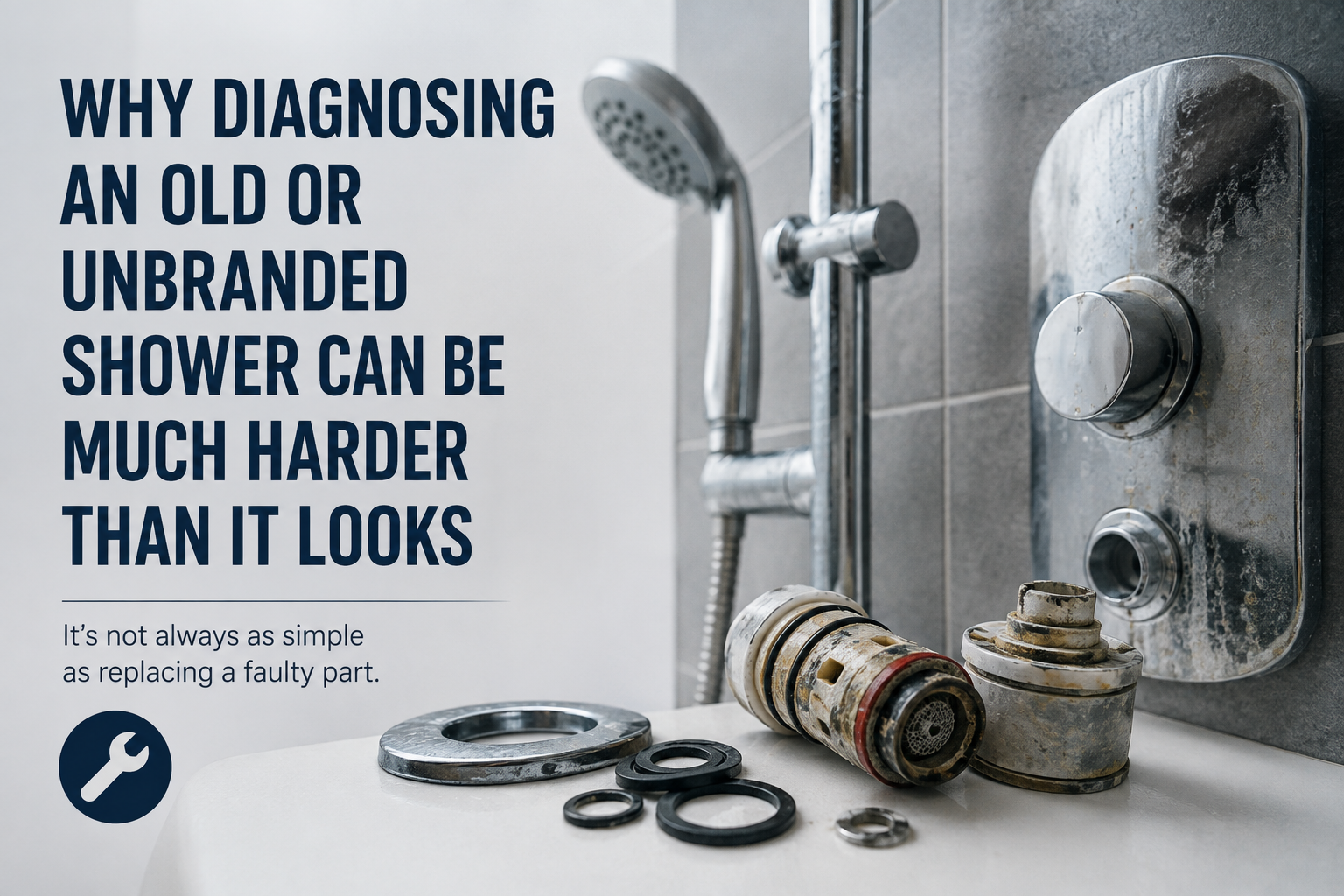
Why diagnosing an old or unbranded shower can be much harder than it looks
When a shower stops working properly, it is understandable that a customer might think the solution is simple:
“Can’t you just replace the faulty part?”
Sometimes the answer is yes.
But with older, unbranded, poorly maintained or heavily worn showers, identifying the actual cause of the problem can be surprisingly difficult. A shower that is running cold, losing pressure, dripping, cutting out or refusing to work properly may have several possible causes — and replacing one component doesn’t necessarily solve the underlying fault.
At Christy Plumbing & Heating, we regularly attend showers where the customer has already been told, or reasonably assumed, that one particular part will fix everything. Unfortunately, plumbing and shower systems don’t always work that way.
A shower is a system, not just one component
A shower can contain or rely upon a number of components working together, including:
- The shower valve or mixer
- Thermostatic cartridge
- Flow control
- Diverter
- Check valves
- Filters
- Shower head and hose
- Pump, where fitted
- Hot and cold water supplies
- Isolation valves
- Pipework
- Electrical components on electric or digital showers
- Internal seals and diaphragms
- Pressure and temperature regulation
If one part isn’t working correctly, another component may also be affected.
For example, poor flow from the shower head could be caused by the shower head itself — but it could also be caused by a blocked filter, a restriction in the valve, poor water pressure, a failing pump or an issue with the incoming supplies.
Simply changing the shower head might therefore make little or no difference.
“The cartridge must be faulty” — but is it?
Thermostatic cartridges are a common source of shower problems, particularly on older showers.
A cartridge can become worn, scaled up or damaged. It may cause:
- Water that won’t get hot enough
- Temperature fluctuations
- Poor flow
- A shower that won’t shut off properly
- Water coming through when it shouldn’t
- Difficulty adjusting the temperature
But these symptoms don’t automatically mean the cartridge is the problem.
The cartridge could be functioning correctly while another part of the system is causing the symptom.
This is why a competent plumber should diagnose the shower before simply ordering a replacement component.
The problem with old and unbranded showers
Modern showers from established manufacturers will normally have identifiable model numbers, replacement parts information and technical documentation.
That makes diagnosis considerably easier.
With an older or unbranded shower, things can be very different.
We may encounter a shower where:
- There is no visible manufacturer
- The model number has disappeared
- The shower has been installed for many years
- Replacement parts are no longer manufactured
- Several visually similar cartridges are available
- Previous repairs have been carried out
- Parts from different manufacturers have been fitted
- The shower has suffered from limescale
- Filters or internal components have never been maintained
- The original installation doesn’t meet current expectations
- Access to the internal components is extremely restricted
In these circumstances, identifying the correct component can become a job in itself.
Why plumbers can’t always diagnose a shower fault in five minutes
A customer sees the end result:
“The shower isn’t getting hot.”
A plumber sees a number of possible causes.
Is the hot water supply reaching the shower?
Is the cold water pressure correct?
Are the isolation valves fully open?
Are filters blocked?
Is the cartridge operating correctly?
Is the thermostatic element responding?
Is there a restriction in the pipework?
Is the shower receiving the correct flow?
Is a pump operating correctly?
Is there a problem elsewhere with the hot water system?
Has somebody previously altered or repaired the shower?
These questions have to be worked through before a plumber can confidently identify the root cause.
Sometimes this means removing parts, testing the water supplies, inspecting filters and valves, checking temperatures and pressures, and examining the condition of the shower itself.
The danger of “just replace the part”
Replacing a part without properly diagnosing the fault can result in an expensive cycle of trial and error.
For example:
Customer: “The shower isn’t getting hot.”
Part replaced: Thermostatic cartridge.
Result: Still not hot.
Next part: Flow control.
Result: Still not hot.
Next part: Check valve.
Result: Still not hot.
At this point, the customer may have spent considerably more money and still have the original problem.
A professional diagnosis should aim to establish why the shower is malfunctioning before recommending a repair wherever reasonably possible.
Sometimes the part is the problem — and sometimes the shower is the problem
There is another important consideration with older showers.
Even if we identify a failed component, that doesn’t necessarily mean replacing it is the best long-term solution.
If a shower is 15 or 20 years old, has significant limescale, worn seals, obsolete components and evidence of previous repairs, spending money replacing one component may only provide a temporary solution.
There may be another component close behind it in terms of failure.
In these circumstances, we may recommend comparing the cost of repair with replacement.
That isn’t about selling a new shower unnecessarily.
It is about making sure the customer understands the likely condition of the whole appliance rather than simply replacing one component and hoping for the best.
Why replacement parts aren’t always straightforward
Another common misconception is:
“You can get every part for every shower.”
Unfortunately, that’s not the case.
Manufacturers discontinue products. Companies cease trading. Models change. Cartridges are modified. Dimensions differ. And some showers were installed without any readily identifiable model information.
Even when a replacement cartridge appears visually identical, it may not be the correct component.
A plumber may therefore need to identify the shower, measure components, inspect the existing part and research whether a suitable replacement is actually available.
Sometimes the correct replacement part simply cannot be obtained.
Poor maintenance makes diagnosis harder
Limescale and lack of maintenance can make an already difficult diagnosis considerably more complicated.
Internal components can become difficult to remove. Filters can become blocked. Moving parts can seize. Seals can deteriorate.
In some cases, attempting to dismantle an old shower can reveal additional problems that weren’t apparent from the original symptom.
This is particularly important with showers that have been in service for many years without maintenance.
What customers can do to help
If your shower develops a fault, there are a few things that can make diagnosis much easier.
If possible, provide:
The manufacturer and model number
Photographs of the shower can also be extremely useful, particularly if the manufacturer or model isn’t obvious.
Tell the plumber exactly what is happening rather than simply saying that the shower is “broken”.
For example:
- It runs hot for two minutes and then goes cold.
- The flow has gradually reduced.
- The temperature fluctuates.
- It drips after being switched off.
- The shower won’t turn off.
- It works downstairs but not upstairs.
- The shower has become progressively worse.
- It suddenly stopped working.
These details can provide important clues.
What you should expect from a professional diagnosis
When dealing with an older or problematic shower, the first visit may need to be primarily diagnostic.
The plumber should establish, as far as reasonably possible:
- What the customer is experiencing.
- What type of shower has been installed.
- Whether the shower can be correctly identified.
- Whether the hot and cold supplies are reaching the shower.
- Whether there are restrictions or obvious blockages.
- Whether the internal components appear to be operating correctly.
- Whether replacement parts are available.
- Whether repair is technically and economically sensible.
- Whether replacement should be considered.
Sometimes the answer will be a straightforward repair.
Sometimes the answer will be that a particular part needs replacing.
And sometimes the honest answer is:
“We can see the problem, but repairing this old shower is unlikely to be reliable or cost-effective.”
That’s much better than repeatedly replacing parts without solving the underlying issue.
A repair isn’t always the same as a solution
One of the most important things for customers to understand is that symptom and cause aren’t always the same thing.
A shower that isn’t getting hot doesn’t necessarily have a faulty thermostat.
A shower with poor flow doesn’t necessarily need a new shower head.
A shower that drips doesn’t necessarily need a new cartridge.
And a shower that stops working doesn’t necessarily have one simple failed component.
The job of the plumber is to investigate the system and establish the most likely cause before recommending the appropriate course of action.
At Christy Plumbing & Heating, we believe in diagnosing before replacing
We understand that customers want their shower fixed quickly and don’t want to pay for unnecessary parts.
That’s why, particularly with older, unbranded or poorly maintained showers, we believe it is important to take the time to investigate the fault properly.
Where a repair is practical, we’ll explain what is required.
Where a replacement part is available, we’ll explain the options.
And where the shower is old, obsolete or uneconomical to repair, we’ll explain why replacement may make more sense.
The aim isn’t simply to replace a part. The aim is to find the cause of the problem and provide the customer with the most sensible solution.
If your shower is giving you problems, particularly if it is an older or unidentified model, don’t assume that one replacement part will automatically solve the issue.
A proper diagnosis could save you money, prevent unnecessary parts being replaced and, most importantly, get to the real cause of the problem.